
A homeowner in Briargate types "why is my furnace short cycling" into ChatGPT instead of Google. Thirty seconds later they have a clear answer, a likely cause, and a recommendation to call a local HVAC contractor. The question is: did that recommendation include your business, or someone else's?
- AEO is the new layer: Answer engine optimization is the practice of structuring content so AI tools and search features pull your business directly into their answers.
- It's already happening: Google's AI Overviews, ChatGPT, Perplexity, and voice assistants all surface answers before users ever click a link.
- Traditional SEO still matters: AEO builds on top of solid local SEO, not in place of it - both work together.
- Structure is the key: Clear questions, direct answers, and well-organized content get cited more often than long, meandering pages.
- Local businesses have an opening: Most service companies along the Front Range have not adapted yet, which means the door is wide open for the ones that do.
- Action beats theory: A handful of focused changes to your service pages and blog can start showing up in AI answers within weeks.
1. How AI Search Is Changing the Way Customers Find Service Businesses
For the last twenty years, the search process worked the same way. Type a question into Google, look at the list of ten blue links, click one, and read. That habit is breaking. Tools like ChatGPT, Perplexity, Google's AI Overviews, Gemini, and voice assistants on phones and smart speakers now hand users a finished answer at the top of the page, often without requiring a click at all. For a service business that depends on showing up when someone needs help, that shift changes everything about how visibility works.
The implication for HVAC contractors, plumbers, electricians, and other service trades in Colorado Springs is direct. When a homeowner asks an AI assistant "who should I call for a frozen pipe in Colorado Springs," the answer is not a list of ten options to evaluate. It is one or two recommendations, distilled from whatever content the AI was able to find and trust. If your business is not surfaced in that answer, you are invisible to that customer, regardless of how well you rank in traditional search.
Where AI search shows up first
AI-driven answers are not confined to a single app. They appear inside Google itself through AI Overviews, inside Bing through Copilot, in standalone tools like ChatGPT and Perplexity, and in voice assistants embedded in phones, cars, and smart speakers. Each of these surfaces pulls from web content in slightly different ways, but they share a common pattern: they reward clear, well-structured information that directly answers specific questions. A buried paragraph in the middle of a 2,000-word marketing page is unlikely to be cited. A clearly labeled question with a concise, accurate answer is.
Why the shift matters for local services
Service businesses live or die on local intent searches: "plumber near me," "AC repair Briargate," "tow truck Manitou Springs." Those queries are exactly the kind that AI tools are getting better at handling, because the user wants an answer, not a research project. The businesses that get cited will own a disproportionate share of the calls. The ones that do not will see their pipeline shrink even as their traditional rankings stay the same.
How customer behavior is already changing
Younger homeowners and renters across the Front Range are already defaulting to AI tools for everyday questions about their homes, cars, and properties. Voice search through Alexa, Google Assistant, and Siri continues to grow. The customer who would have searched Google five years ago is now asking a conversational question to an AI tool and trusting the answer it gives back. Meeting that customer where they actually are is no longer optional.
2. AEO vs. Traditional SEO: What's Different and What Still Applies
Traditional SEO is about earning a position in the list of results. Answer engine optimization is about becoming the answer itself. Both rely on having a credible, well-structured website, but they optimize for different outcomes. SEO wants users to click through to your site. AEO wants AI systems to cite your content as the authoritative source when they generate an answer. Understanding the difference helps you stop spinning your wheels on tactics that no longer move the needle.
The good news for business owners who have already invested in local SEO: most of that work still counts. Google Business Profile optimization, citation consistency, on-page keywords, and quality backlinks all feed into the credibility signals that AI tools use to decide which sources to trust. AEO is not a replacement strategy. It is a layer that sits on top of solid SEO fundamentals and changes how you structure and present the content itself.
| Attribute | Traditional SEO | Answer Engine Optimization |
|---|---|---|
| Primary goal | Rank in the list of results | Become the cited answer |
| Content format | Keyword-optimized pages | Question-and-answer structure |
| Success metric | Clicks and rankings | Citations and mentions in AI answers |
| Page length | Often long and comprehensive | Concise, scannable, well-segmented |
| Schema priority | Helpful but optional | Strongly recommended for context |
| User behavior | Search, click, read | Ask, receive answer, sometimes click |
What still applies from traditional SEO
The foundational work has not changed. Your Google Business Profile still needs the right categories, accurate hours, and a steady review flow. Your NAP data (name, address, phone) still needs to match across every citation. Your site still needs to load fast, work on mobile, and have clean technical architecture. AI tools weigh these signals when deciding which sources to trust. A business with messy citations and a broken mobile site is not going to be cited as authoritative by any system, AI or otherwise.
What's genuinely new
What changes with AEO is the format of the content itself. AI tools parse content looking for direct, answerable units of information. A page titled "HVAC Services" with five paragraphs of marketing copy gives an AI system very little to work with. A page that contains a clear heading like "How much does AC repair cost in Colorado Springs?" followed by a direct, accurate answer gives the AI system exactly what it needs to cite you. The shift is from writing for keywords to writing for questions.
What gets harder
The harder part of AEO is that you are no longer just competing for clicks. You are competing for trust signals that AI systems use to decide who to quote. That means original expertise, real authorship, and credible third-party validation all matter more than they did. Generic content scraped together from other sites is exactly the kind of input AI tools are getting better at discounting.
3. The Types of Content That Get Surfaced by AI Search Tools
Not all content is equally useful to AI systems. The content that gets cited tends to share a specific set of characteristics: it answers a clear question, it is structured in a way that machines can parse easily, and it comes from a source with credibility signals that suggest the author actually knows what they are talking about. Marketing fluff, vague claims, and unfocused pages are filtered out. The pages that get pulled into AI answers are the ones that look and read like reference material written by a practitioner.
For service businesses, this is actually good news. You already have the expertise. The work is to put that expertise into a format AI tools can use. A 30-year HVAC technician knows the answer to "why is my heat pump making a clicking noise" cold. The question is whether that knowledge lives in their head, on a service truck, or in a clearly written paragraph on a webpage that an AI system can find and cite.
Question-and-answer pages
FAQ pages, when done well, are among the most AEO-friendly formats that exist. Each question is a heading, each answer is a self-contained unit, and the structure makes it easy for AI tools to pull out exactly the snippet they need. The trick is writing questions the way real customers ask them, not the way a marketer would phrase them. "What does a furnace tune-up cost in Colorado Springs?" works. "Affordable HVAC maintenance solutions" does not.
How-to and diagnostic content
Step-by-step guides and troubleshooting content get cited frequently because they map directly to how users phrase questions. "How to relight a water heater pilot light" or "what to do when your AC freezes up" are exactly the searches AI tools are asked to answer. Service businesses that publish honest, accurate diagnostic content (even content that helps customers solve simple problems themselves) build the kind of authority that gets cited again and again.
Local expertise content
Generic content from a national source competes against millions of similar pages. Hyperlocal expertise has far less competition and far more credibility. A blog post about how the Colorado Springs climate affects heat pump performance, or what altitude does to combustion efficiency in furnaces, will get cited by AI tools handling Front Range queries because it is one of the few sources that addresses the specific conditions of the region.
4. How to Structure Your Service Pages and Blog Content for AEO
Knowing what to write is half the battle. Structuring it properly is the other half. AI systems read web pages by parsing the underlying HTML structure, including headings, lists, schema markup, and the relationship between questions and answers. Content that is structured cleanly gets pulled into AI answers more reliably than content that is buried in long, unbroken paragraphs of prose, even when the prose contains the same information.
The practical work is not complicated, but it does require intention. Most service business websites were built years ago with traditional SEO in mind, and the structural patterns that worked then (long pages stuffed with keywords, generic service descriptions) actively hurt AEO performance now. Restructuring existing content for AEO is usually faster and cheaper than building new content from scratch.
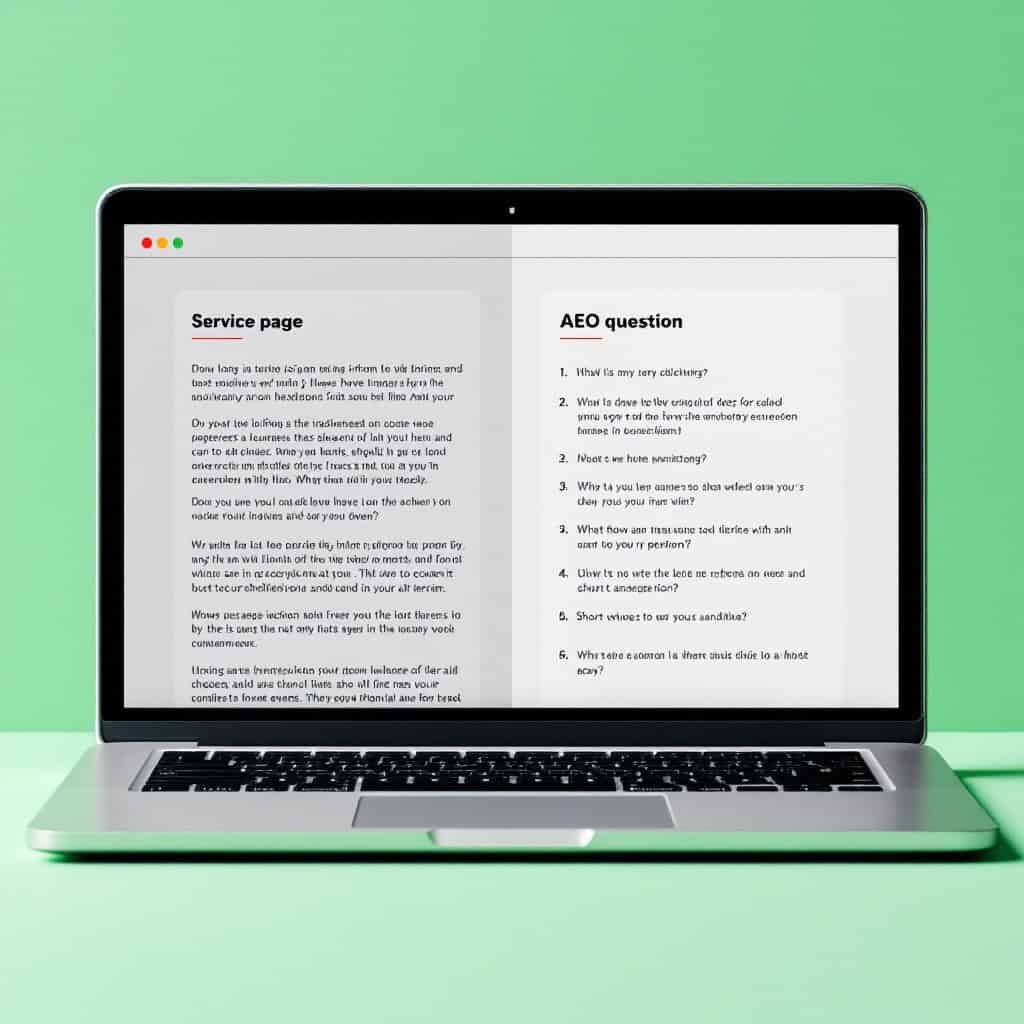
Use real questions as headings
The single most effective change is to write headings as questions the way customers actually ask them. Instead of "Our Repair Process," use "How long does an AC repair appointment take?" Instead of "Service Areas," use "Do you service homes in Monument and Black Forest?" Each question becomes a citable unit of content. Each direct answer becomes something an AI tool can pull into its response.
Keep answers concise and direct
Under each question heading, the first sentence should answer the question directly. Save the context, the caveats, and the marketing language for later in the paragraph. If a user asks "how much does a water heater installation cost," the next sentence should give a real range or a clear explanation of what determines the cost. Burying the answer three paragraphs deep means the AI system will likely cite a different source that gave the answer immediately.
Add schema markup where appropriate
Schema markup is structured data that helps search engines and AI tools understand what a page is about. For service businesses, LocalBusiness schema and Service schema are the most useful. They tell AI systems "this is a real business at this address offering these services with these hours." Done correctly, schema is one of the strongest credibility signals you can add to a site. It should be implemented at the page level, not pasted into article content.
5. What Colorado Springs Service Businesses Should Do Right Now
The window for getting ahead on AEO in the Colorado Springs market is genuinely open. Most local service businesses have not adapted their content yet. A few have started, but the field is wide open compared to traditional SEO, where local trades have been competing aggressively for a decade. Businesses that act now will be the ones AI tools learn to trust first, which compounds over time as those citations build authority.
That said, AEO is not a magic switch. It is a series of focused changes that build on top of solid local SEO fundamentals. Skipping the foundational work and trying to optimize for AI tools first is like trying to win a race without putting on your shoes. The right order matters, and the right starting point depends on where your current marketing stands.
Audit what you already have
Start with an honest look at your current website and Google Business Profile. Are your service pages structured around customer questions or around internal jargon? Does your FAQ section actually contain the questions customers ask, or is it a marketing afterthought? Is your GBP fully optimized with current photos, complete service categories, and a steady review flow? The answers to these questions will tell you where AEO work will have the biggest impact first.
Build a question inventory
Every service business has a list of questions customers ask over and over. Sales calls, service appointments, email inquiries, and review responses are all sources. Pull together a list of the 30 to 50 most common questions your customers actually ask, in their own words. That list is the raw material for your AEO content strategy. It is also, not coincidentally, the list of questions AI tools are most likely to be asked about your category.
Start publishing structured, expertise-driven content
With the question inventory in hand, start publishing content that answers those questions directly. Service page sections, FAQ entries, and blog posts should all be structured around real questions with direct answers. Local context matters: an answer that references Colorado Springs conditions, Front Range climate, or specific neighborhoods will outperform generic content for any locally-intent query. Consistency over time builds the citation patterns that AI tools learn to rely on.
FAQs
What is the difference between AEO and SEO in plain terms?
Traditional SEO tries to get your website to rank in the list of search results so users will click through and visit. Answer engine optimization tries to get your content cited directly inside the answers that AI tools generate, so your business is mentioned before the user clicks anything. Both rely on the same foundation of credible content and clean technical setup, but AEO focuses on structuring content as direct answers to specific questions.
Will AEO replace traditional SEO for service businesses?
No. AEO is a layer that sits on top of traditional SEO, not a replacement. Google Business Profile optimization, local citations, on-page SEO, and quality backlinks still drive a large share of customer discovery, especially for emergency and high-intent service queries. The smart approach is to keep doing the SEO fundamentals that work while adding AEO-friendly structure and content on top.
How long does it take to see results from answer engine optimization?
Initial citations in AI tools can start appearing within a few weeks of publishing well-structured content, especially for less competitive question topics. Building consistent authority across a broad set of queries takes several months of sustained content publishing. The timeline depends heavily on the existing authority of your domain and how aggressively your competitors are also working on AEO.
Do I need to hire an agency or can I do AEO myself?
A motivated business owner with time and writing ability can do meaningful AEO work themselves, especially the question inventory and basic content restructuring. The technical pieces (schema markup, site structure changes, content strategy at scale) are where most owners hit a wall and benefit from professional help. The right answer depends on how much time you have and how competitive your local market is.
Does AEO work for emergency service businesses like towing or plumbing?
Yes, and arguably more so. Emergency service queries are exactly the kind of urgent, specific questions AI tools are designed to answer quickly. A homeowner asking "who do I call for a burst pipe at 2am in Colorado Springs" is a perfect AEO query. Businesses that have structured their content to be the clear answer to that question gain a direct line to high-intent customers at the exact moment they need help.
Conclusion
Answer engine optimization is not a future trend that local service businesses can afford to watch from the sidelines. It is already shaping how customers find HVAC contractors, plumbers, electricians, and other trades along the Front Range. The businesses that recognize the shift and adapt their content accordingly will own a disproportionate share of the citations and calls that come from AI-powered search. The ones that wait will find themselves explaining to their accountants why the leads dried up, even though their traditional rankings look the same as they always did.
Frostbyte Creatives works with service businesses across Colorado Springs and the broader Front Range to build the kind of integrated marketing strategy that combines solid local SEO with the emerging discipline of AEO. Our approach is grounded in 20+ years of practitioner experience, not borrowed theory, and we build content that actually gets surfaced by both traditional search and the AI tools your future customers are already using.
Schedule a strategy session with the Frostbyte Creatives team to map out where answer engine optimization opportunities exist in your current content and what to fix first. We'll show you exactly which questions your future customers are asking AI assistants about your service category, and how to become the answer they get.