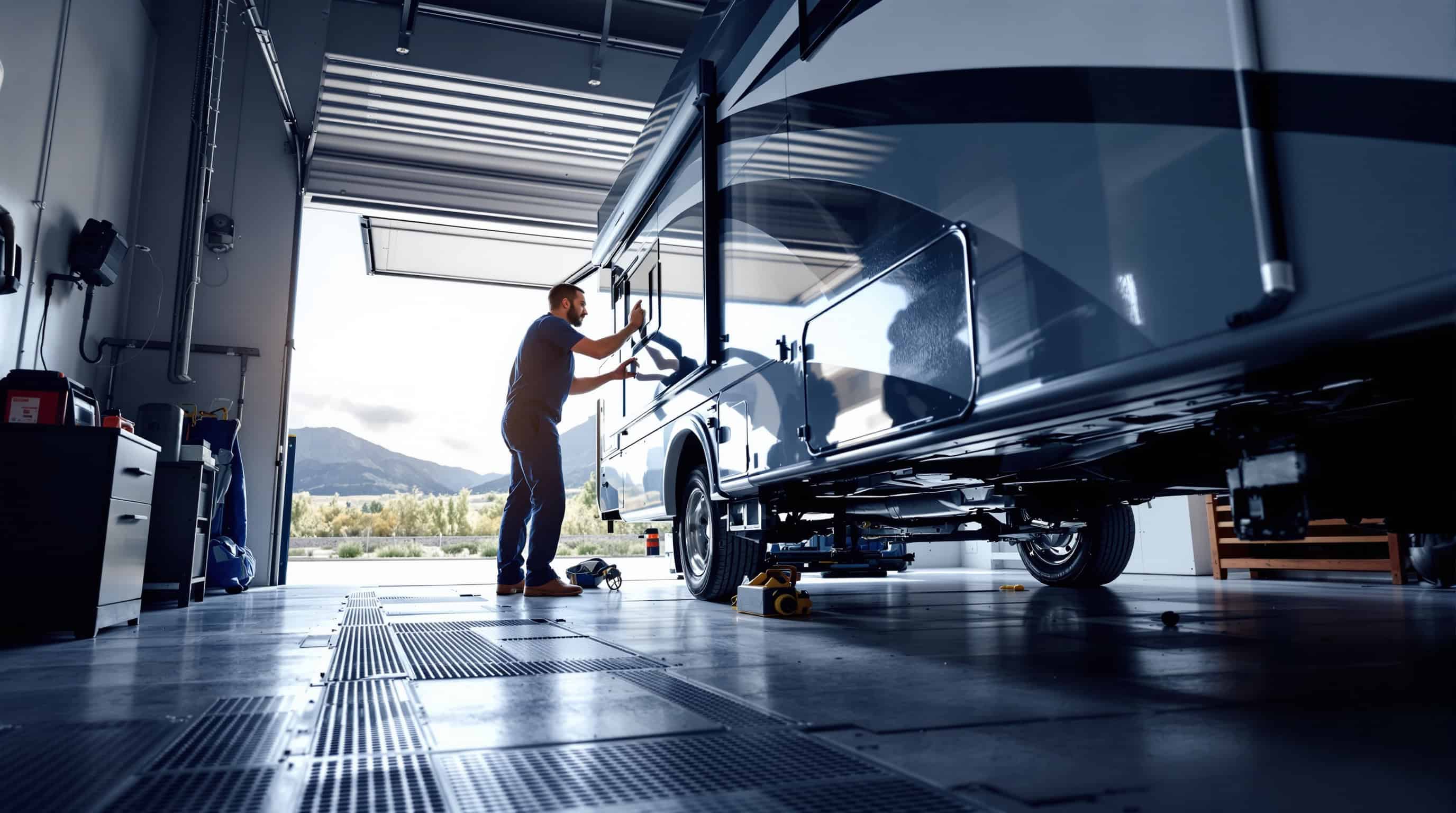
A motorhome pulls off I-25 near Monument with a coolant leak spreading under the engine bay, and the driver is three states from home with a campground reservation waiting in Woodland Park. They pull out a phone, type "RV repair near me," and pick from whatever shows up on the map in the next ninety seconds. That search happens dozens of times a week along the Front Range corridor between April and September, and most RV repair shops never show up for it because their online presence was built for a different kind of customer.
Key Takeaways
- Seasonal demand requires seasonal preparation: RV repair searches climb sharply each spring, and the shops that update their online presence in the off-season are the ones ranking when the rush hits.
- Local SEO for service businesses covers two audiences at once: RV shops need to rank for both repeat local RV owners and one-time travelers who have never heard of your town before their check engine light came on.
- Google Business Profile is the single highest-leverage asset: hours, service categories, photos, and review responses directly affect whether a stranded traveler finds you or your competitor down the road.
- Content answering repair questions builds trust before the call: RV owners research symptoms before they book, and shops that answer those questions on their website earn the click.
- Highway-adjacent visibility matters as much as downtown visibility: travelers search differently than locals, and your SEO strategy needs to account for both search patterns.
1. Why RV Repair Demand Spikes Every Spring and Summer
RV ownership follows the calendar in a way most service trades do not. Owners who parked their rigs in storage over winter pull them out in spring, and that first startup after months of sitting is when batteries fail, seals dry out, and slide-outs stick. Add in the wave of new RV buyers who purchased over the winter months and are taking their first extended trip, and repair shops see a compressed surge of demand that starts around the spring thaw and runs through Labor Day.
Colorado's high-altitude climate compounds this. Freeze-thaw cycles through the winter are hard on plumbing lines, seals, and awning mechanisms, so a rig that sat in Woodland Park or Monument through a Front Range winter often needs more attention before its first trip than one stored in a milder climate. Then, once travel season starts, Colorado Springs sits directly on a major north-south corridor and within a short drive of Pikes Peak, Garden of the Gods, and the mountain routes that draw RV traffic all summer. That combination of local seasonal wake-up demand and cross-country pass-through traffic is unique to shops in this region, and it means the search volume for RV repair terms behaves differently here than in a market without heavy tourist and defense-related travel.
The local demand curve
Local RV owners in Colorado Springs, Fountain, and Pueblo tend to search in a predictable window: late March through May, as they prep rigs for the season, and again in September and October as they winterize. These searches are more likely to include brand names, specific part terms, and scheduling language like "RV winterization appointment."
The traveler demand curve
Traveler searches spike from Memorial Day through Labor Day and are almost entirely reactive. Someone does not search "RV repair" in April planning a July trip. They search it the moment something breaks, usually from a rest stop, a campground, or the shoulder of the highway, which means your shop needs to already be visible before that moment arrives.
2. The Specific Search Terms RV Owners Use Before They Book
Understanding the exact phrases RV owners type matters more in this trade than in most, because the searcher's intent and urgency vary so widely from one query to the next. A local owner planning ahead searches differently than someone with smoke coming from a wheel well on Highway 24. Local SEO for service businesses only works when the content and metadata on your site match the actual language searchers use at each stage.
Generic terms like "RV repair Colorado Springs" still matter, but they carry heavy competition and mixed intent. The terms that convert best are usually more specific: symptom-based searches, brand-and-model searches, and urgency-based searches. A shop that only optimizes for the broad category term is leaving a large share of high-intent traffic on the table.
Symptom-based searches
Phrases like "RV slide out won't retract," "camper AC not blowing cold," or "motorhome leveling jacks not working" represent a searcher trying to self-diagnose before calling anyone. These searches often happen at 9 p.m. in a campground with spotty signal, and the business whose website or Google Business Profile answers the question directly earns a disproportionate share of the eventual phone calls.
Brand and model searches
RV owners frequently search by manufacturer, since certain systems (slide mechanisms, generator brands, awning motors) are proprietary to specific builders. Terms like "Forest River slide repair near me" or "Onan generator service Colorado Springs" indicate a searcher who already knows what is wrong and wants a shop with specific experience. If your site or GBP profile lists the brands and systems you service, you rank for searches your generalist competitors never capture.
Urgency and location-modified searches
"Emergency RV repair," "mobile RV mechanic near me," and "RV repair open now" are searches from people who need help immediately, often from the road. These terms have lower search volume but extremely high conversion intent, and they reward businesses with accurate hours, mobile service listings, and same-day availability clearly stated on their Google Business Profile.
3. Optimizing Your Google Business Profile for Seasonal Traffic
For a business that lives on both scheduled local work and unscheduled traveler emergencies, Google Business Profile is the single most important piece of digital real estate you control. It is free, it is what shows up first on mobile searches near a highway exit, and it is the profile Google pulls from when someone asks a voice assistant to find the nearest RV repair. A profile that is accurate, complete, and actively maintained through the season consistently outperforms a profile that gets updated once a year.
The mistake most shops make is treating their GBP listing as a one-time setup task instead of a living asset that needs seasonal attention. Hours change around holidays, service capacity shifts as the season gets busier, and photos that looked current two years ago start to look stale. Google's own guidance on Google Business Profile optimization is explicit that complete, accurate, and frequently updated profiles perform better in local search results than static ones.
Here is a comparison of what a seasonally optimized profile looks like against a neglected one:
| Profile Element | Neglected Profile | Seasonally Optimized Profile |
|---|---|---|
| Business hours | Generic hours, not updated for peak season | Extended summer hours clearly listed, holiday exceptions added |
| Service categories | Just "RV repair shop" | Specific categories added: mobile RV repair, RV dealer, auto repair shop |
| Photos | A handful of old exterior shots | Recent photos of the service bay, technicians at work, before-and-after repairs |
| Q&A section | Empty or unmonitored | Common questions pre-answered by the business |
| Review responses | Sporadic or missing | Every review responded to within a few days |
| Posts | Never used | Weekly posts about availability, seasonal tips, or specials |
A profile with those seasonal elements in place before the spring surge starts is far more likely to appear in the local map pack when a traveler searches from a phone on the shoulder of I-25. Waiting until June to fix an outdated profile means missing the exact weeks when search volume is highest.
4. Building Content Around Common Repair and Maintenance Questions
Most RV owners try to understand a problem before they call anyone about it. That research phase, whether it lasts five minutes or two days, is an opportunity for your website to build trust before the phone even rings. A shop that publishes clear, accurate answers to the questions RV owners are already typing into Google positions itself as the obvious call when the reader decides they need professional help.
This is where local SEO for service businesses overlaps directly with content strategy. Search engines, and increasingly AI-powered search tools, favor pages that answer a specific question clearly and completely rather than pages stuffed with generic service descriptions. A single well-written page titled "Why Is My RV Awning Not Retracting" that walks through the common causes will often outperform a broad "RV Services" page for the searches that actually drive bookings.
Seasonal maintenance guides
Content built around spring de-winterization, pre-trip inspection checklists, and end-of-season winterization steps serves local owners exactly when they are searching for that information. These guides also demonstrate expertise in a way that builds trust with a reader who has never used your shop before.
Symptom diagnosis pages
Pages that walk through the likely causes of a specific problem, generator won't start, slide leaks water, brakes grinding, capture the exact symptom-based searches covered earlier. These pages should be honest about which issues are simple fixes and which require a professional, since that honesty is what earns the eventual call.
Local and regional travel content
Content addressing Colorado-specific concerns, such as how high altitude affects propane appliances or what mountain grades do to towing setups, speaks directly to the traveler audience passing through on their way to the mountains and gives your site relevance for searches tied to the region rather than just the repair category.
5. Getting Found by Travelers Passing Through, Not Just Locals
A local plumber or HVAC company can build an SEO strategy almost entirely around ranking in their own city. An RV repair shop cannot, because a meaningful share of demand comes from people who have never been to Colorado Springs before and will likely never return. That changes what "local SEO for service businesses" needs to mean for this trade specifically. The strategy has to account for search behavior tied to a highway corridor, not just a city name.
Travelers rarely search a shop by name, because they don't know any names yet. They search by proximity and urgency: "RV repair near me," "RV mechanic on I-25," or simply rely on the map results that appear automatically when their phone detects they are searching near a highway exit. Winning that search means your Google Business Profile pin, your service area settings, and your visibility along the corridor all need to be dialed in, not just your presence for "Colorado Springs" as a keyword.
Service area configuration matters more than city targeting
If your shop offers mobile repair or roadside service, your Google Business Profile service area settings should reflect the actual radius you cover along I-25, not just the city limits. A profile configured only for Colorado Springs proper may not surface for a search originating near Fountain or Monument, even though your shop is close enough to respond.
Highway-adjacent content and structured data
Pages that mention proximity to specific corridors, exits, or landmarks (the North Academy Boulevard corridor, or routes toward Woodland Park and the mountain passes) help both search engines and AI-powered answer tools understand where your shop sits relative to a traveler's location. This kind of geographic specificity is exactly the sort of context that Google's AI Overviews and similar tools pull from when answering a "nearest RV repair" style query.
Reviews that mention travel context
A review that says "we broke down on our way through Colorado Springs and they got us back on the road same day" carries weight with future travelers reading it under similar circumstances. Encouraging travelers to leave a review before they continue their trip, even a short one, builds a body of social proof that speaks directly to the audience most likely to need you again in an emergency.
6. Preparing Your Online Presence Before the Rush Hits
The shops that perform best during peak season are rarely the ones scrambling to fix their website in May. Local search rankings do not shift overnight. Google needs time to crawl updated content, recognize a more complete Google Business Profile, and accumulate the fresh reviews and posts that signal an active, trustworthy business. That lag is exactly why the off-season, not the rush, is the right time to do this work.
A realistic preparation timeline starts well before the first warm week of spring. Reviewing and updating your Google Business Profile, auditing your website for outdated service pages, and publishing a batch of maintenance and symptom-based content all take weeks to show measurable movement in rankings. Shops that treat this as a January-through-March project consistently outperform shops that start in April, simply because they had a head start on the algorithm's timeline.
Auditing what is already broken
Before adding anything new, check what is already underperforming. Outdated hours, an old phone number still listed somewhere, broken contact forms, and unanswered reviews from the prior season are all small issues that compound. A quick audit of your Google Business Profile, website contact information, and directory listings (Yelp, RV-specific directories, local chamber listings) catches the errors that quietly cost bookings all season.
Refreshing photos and proof of work
Photos matter more than most shop owners assume, particularly for a trade where customers are trusting a stranger with an expensive vehicle. Fresh photos of the service bay, technicians mid-repair, and before-and-after shots of common jobs (slide mechanisms, roof seals, generator work) give both local customers and anxious travelers confidence that your shop is active, capable, and current.
Staffing your response capacity
Local SEO drives the traffic, but a listing that gets calls and never gets answered, or reviews that never get a response, undermines the work. Before the season ramps up, make sure whoever is answering the phone or monitoring the GBP messaging feature has the bandwidth to respond quickly, since travelers in particular tend to move to the next result if they don't hear back within a few minutes.
7. Measuring Results and Adjusting Before Next Season
Local SEO work only earns its keep if you know whether it is working, and for a seasonal trade that means measuring at the right intervals rather than waiting for an annual review. Watching a handful of consistent signals through the season tells you whether your preparation paid off and gives you real data to act on before the next cycle starts.
Google Business Profile provides built-in insights showing how customers found your listing, whether through direct search, discovery search, or map views, along with the actions they took, such as calls, direction requests, or website visits. Reviewing these numbers monthly during the season, rather than once a year, lets you catch a problem (a sudden drop in map visibility, a spike in views without matching calls) while there is still time to fix it before the summer ends.
Signals worth tracking through the season
Track call volume and its source, review velocity (how many new reviews you're earning and how quickly), and which specific pages on your website are getting traffic from search. If your symptom-based content pages are getting traffic but few calls, that may point to a slow-loading page, an unclear contact method, or a page that answers the question so completely the reader never feels the need to call, which is worth adjusting.
Turning end-of-season data into next year's plan
The slower months after Labor Day are the right time to review what worked. Which search terms actually drove bookings this year? Which content pages underperformed? Which competitors gained ground in the map pack? Documenting those answers while the season is still fresh means your preparation for the following spring starts from real data instead of guesswork.
FAQs
How far in advance should an RV repair shop start local SEO before summer season?
Start at least two to three months before your local demand curve typically picks up, generally by late winter. Google Business Profile changes and new content both take time to influence rankings, so waiting until spring traffic has already arrived means missing a meaningful share of it.
What is the difference between local SEO for a shop with a fixed location versus a mobile RV repair service?
A fixed-location shop optimizes primarily around its physical address and service area radius, while a mobile service needs its Google Business Profile service area configured to reflect the actual coverage zone, since there is no storefront for customers to visit. Mobile services should emphasize response time and coverage corridors in their content and profile.
Do RV repair shops need a different SEO strategy than other local service businesses?
The core principles of local SEO for service businesses apply, but RV shops need to account for a dual audience: repeat local customers and one-time travelers with no prior familiarity with the area. That means balancing city-specific keywords with corridor and highway-adjacent visibility that a purely local trade would not need.
How important are Google reviews for an RV repair shop specifically?
Reviews are especially important for this trade because travelers are trusting an unfamiliar business with an expensive vehicle under time pressure. A steady flow of recent, specific reviews mentioning quick turnaround or roadside assistance builds the confidence a stranded traveler needs to choose your shop over the next map result.
Can AI-powered search tools like Google AI Overviews send traffic to a local RV repair shop?
Yes, AI-powered search results pull from the same signals as traditional local search, including Google Business Profile completeness, website content that directly answers common questions, and review sentiment. A shop with clear, specific content about repair symptoms and service areas is more likely to be referenced when someone asks an AI assistant to find help nearby.
Conclusion
RV repair sits in an unusual spot for local search strategy, because it demands visibility with two very different audiences at once: the local owner planning a spring de-winterization and the traveler with smoke coming from the engine bay on I-25. Winning both requires more than a basic Google Business Profile and a homepage listing your services. It requires seasonal preparation, content that answers real repair questions, and a search strategy built around highway corridors as much as city limits, all done in the months before demand spikes rather than in the middle of the rush.
Frostbyte Creatives works with Colorado Springs area businesses that compete for exactly this kind of layered local and regional demand, building the local SEO and content strategy that gets a shop found by both its regulars and the traveler who has never heard of the business before their rig broke down on the way to Woodland Park.
Schedule Your Free Strategy Meeting to build a local SEO plan that gets your RV repair shop visible to local owners and highway travelers before the next travel season surge arrives. We'll walk through your Google Business Profile, your content gaps, and your corridor visibility so you're ready well before the rush starts.