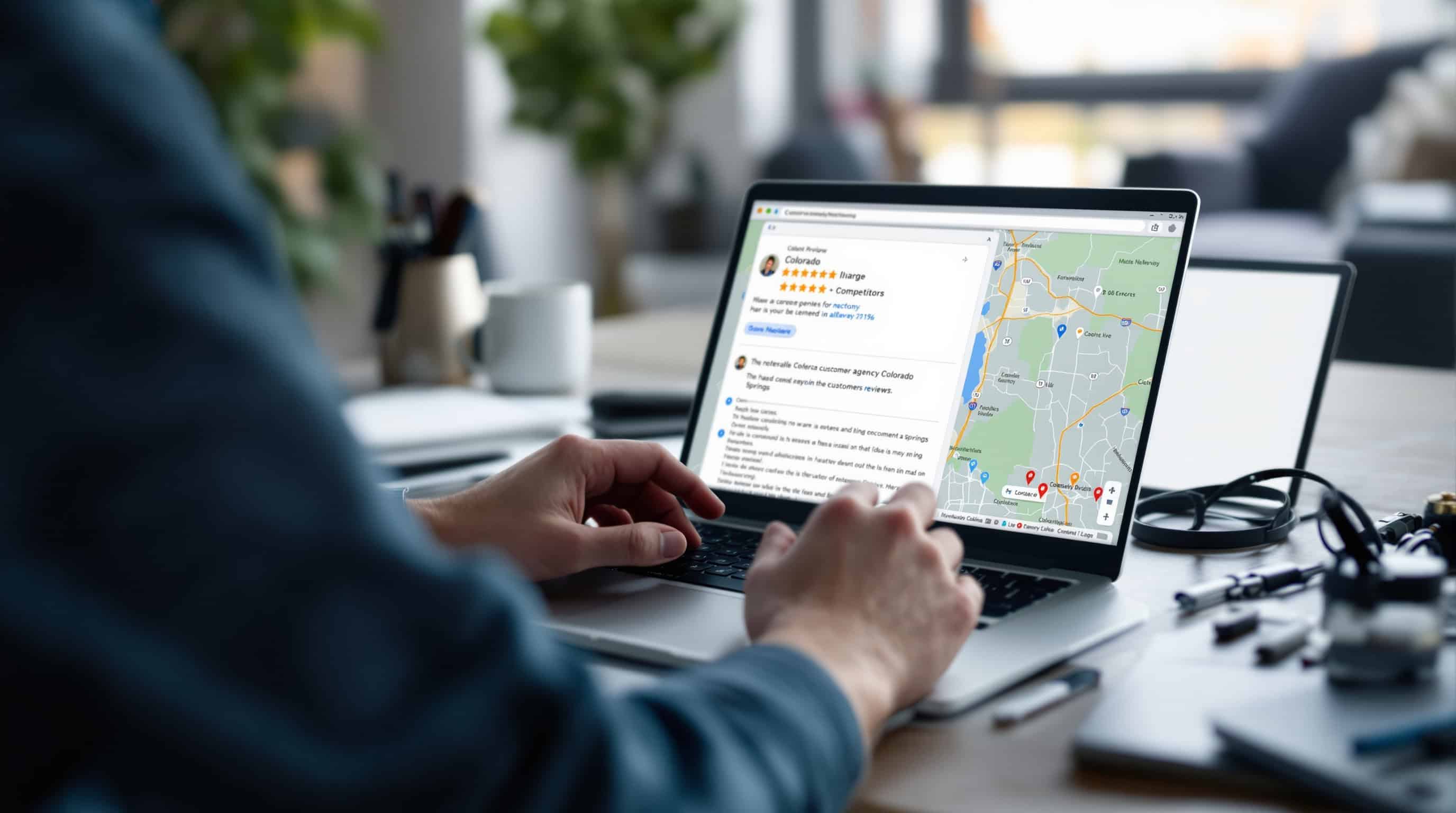
A homeowner in Rockrimmon types "plumber near me" into their phone at 9 p.m. after a pipe starts leaking under the sink. They scroll past three companies with similar star ratings, then stop on the one with a recent, detailed response to a two-star review explaining exactly how the issue got resolved. That response, not the star count alone, is what earns the call. This is the layer of reputation management most service businesses never build, and it is quietly deciding who wins the next job.
Key Takeaways
- Reviews are one input, not the whole system: Full reputation management includes monitoring, response protocol, and crisis containment across every platform where customers talk about you.
- Silence during a crisis reads as guilt: A slow or absent response to a bad review or viral complaint does more damage than the original complaint itself.
- Monitoring has to run continuously: Mentions on Google, Facebook, Nextdoor, and industry directories happen whether or not anyone at your business is watching.
- Reputation and local search rankings are linked: Google's local algorithm weighs review signals directly into who shows up in the map pack for searches in Colorado Springs.
- Systems outperform effort: A repeatable process for requesting, monitoring, and responding to feedback protects your reputation even when you are busy running the business.
1. Why Reputation Now Decides Who Gets the Call
Service businesses used to compete on referrals, yard signs, and reputation that traveled slowly through a neighborhood. That reputation now travels instantly and publicly, and it is visible to every prospective customer before they ever pick up the phone. A roofer in Fountain or an HVAC company on the North Academy Boulevard corridor is being evaluated on the same screen where the customer just checked the weather and their bank balance. The businesses that understand this shift treat their online presence as a live asset that needs tending, not a one-time setup task.
The stakes are higher for service businesses specifically because the purchase is trust-driven and often urgent. Nobody is comparison shopping for a plumber the way they browse for shoes. They need someone in their home or on their property, often that day, and they are looking for the fastest signal that a business is competent and honest. Star ratings answer part of that question. What answers the rest is how a business behaves when something goes wrong, which is exactly what most reputation management conversations skip.
The Trust Gap Between Great Service and a Weak Digital Footprint
Plenty of well-run Colorado Springs service businesses deliver excellent work and still lose jobs to competitors with a more complete digital footprint. This happens when a company's real-world quality is not reflected anywhere a customer can see it before they call. A business with five years of satisfied customers but only a handful of stale reviews looks, to a stranger searching at night, less trustworthy than a newer competitor with a steady stream of recent, responded-to feedback.
Why This Matters More for Military and Veteran-Owned Businesses
The Pikes Peak region's defense-driven economy, anchored by Fort Carson, Peterson Space Force Base, Schriever Space Force Base, and the Air Force Academy, means a large share of local customers are military families who relocate often and rely heavily on online reviews to choose vendors quickly in an unfamiliar city. Veteran-owned and military-adjacent service businesses have a natural trust advantage with this audience, but only if that trust is visible online before the first phone call happens.
2. What Reputation Management Actually Includes Beyond Reviews
Most business owners hear "reputation management" and think of review requests: a text or email after a job asking for five stars. That is a real and necessary part of the work, but it is the smallest piece of a much larger system. Full reputation management covers four connected functions: generating fresh feedback, monitoring where your name appears, responding to what shows up, and having a plan for when something escalates beyond a normal bad review.
Treating review generation as the entire strategy leaves three of those four functions unattended, which is exactly where problems compound. A business can have a strong flow of five-star reviews and still get blindsided by a viral complaint on Nextdoor, a misleading listing on a directory nobody checks, or a competitor leaving a fake negative review that sits unanswered for weeks. Each of those scenarios is preventable with a system, and each is expensive to fix after the fact.
Review Generation Done Right
Asking for reviews works best when it is built into the job itself, not bolted on as an afterthought. The strongest results come from asking at the moment of peak satisfaction, right after the work is finished and the customer has expressed they're happy, using a direct link that removes friction from the process. The Google Business Profile Help center outlines acceptable ways to request reviews and explicitly prohibits incentivizing or gating them, which matters because violations can get reviews removed or a listing suspended entirely.
Response Protocol, Not Just Response
Every review, positive or negative, deserves a response, but the response needs a consistent voice and a clear decision tree. Positive reviews get a brief, specific thank-you that reinforces what the customer mentioned. Negative reviews get an acknowledgment, an offline path to resolve the issue, and no defensiveness in the public reply. Businesses that skip this step are relying on the review itself to tell the whole story, when the response is often what a future customer actually reads first.
Directory and Citation Accuracy
Reputation also lives in dozens of places customers never think to mention: Yelp, Angi, the Better Business Bureau, industry-specific directories, and data aggregators that feed information to GPS systems and voice assistants. Inconsistent business names, old phone numbers, or outdated hours across these listings quietly erode trust and confuse the local search signals that determine visibility.
3. Monitoring Your Brand Across Google, Social, and Directories
Monitoring is the function that most service businesses skip entirely, and it is the one that turns a small problem into a public one. A negative review posted on a Tuesday afternoon does not wait for a business owner to happen to check Google that week. Social platforms, review sites, and community forums like Nextdoor operate on their own timeline, and a mention that goes unanswered for days looks very different to a reader than one answered within hours.
Effective monitoring means knowing, in near real time, when your business name, your technicians' names, or your service is mentioned anywhere customers gather. This does not require expensive enterprise software for most service businesses. Google Alerts, native notification settings inside Google Business Profile and Facebook, and periodic manual checks of Nextdoor and relevant local Facebook groups cover the majority of what a Colorado Springs service business needs to track.
Where Reputation Conversations Actually Happen
| Platform | What Gets Said There | Monitoring Difficulty |
|---|---|---|
| Google Business Profile | Star reviews, Q&A, photos | Low, built-in notifications |
| Facebook / Nextdoor | Recommendations, complaints, warnings to neighbors | Medium, requires active group membership |
| Industry directories (Angi, HomeAdvisor, BBB) | Formal complaints, service reviews | Medium, requires periodic manual checks |
| Local news and community forums | Larger disputes, safety concerns | Low frequency, high impact when it happens |
The table above shows why a single-platform strategy fails. A business that only watches Google is blind to a Nextdoor thread where a neighbor is actively warning others away, and a business that only watches social media misses the formal complaint sitting on the BBB profile that shows up in search results for its own name.
Setting Up a Lightweight Monitoring Routine
A sustainable monitoring routine does not require daily obsession, but it does require consistency. A weekly check across Google, Facebook, and Nextdoor, paired with instant notifications turned on for direct reviews and mentions, catches nearly everything before it becomes urgent. The goal is not zero negative mentions; it is knowing about them within hours instead of weeks.
4. Handling a Reputation Crisis Before It Spreads
Every service business eventually has a bad day: a missed appointment window, a technician who was short with a customer, a job that genuinely went wrong. The difference between a minor bump and a lasting reputation problem is almost always the speed and tone of the response, not the severity of the original mistake. Customers researching a business online are remarkably forgiving of an honest mistake handled well, and remarkably unforgiving of silence.
A crisis, for the purposes of reputation management, is any negative event that has the potential to spread beyond the original complaint, whether that's a viral social post, a cluster of negative reviews arriving at once, or a formal complaint that gets picked up by a local Facebook group. The instinct to go quiet, delete comments, or argue publicly with a customer are the three most common mistakes, and each one makes the situation worse because it looks like the business has something to hide.
The First 24 Hours
The first day after a negative event sets the tone for everything that follows. A prompt, calm, specific public acknowledgment (without admitting fault before the facts are confirmed) buys time and signals to onlookers that the business takes the concern seriously. This is also the window to move the detailed conversation offline, through a phone call or direct message, rather than litigating specifics in a public comment thread where every reply is visible to future customers.
When and How to Respond Publicly
Public responses should be short, factual, and free of defensiveness. Apologizing for the customer's experience is not the same as admitting fault, and that distinction matters both for the customer relationship and for any liability concerns. A response that says "we're looking into this and will follow up directly" holds the line while the business gathers facts, and it demonstrates responsiveness to anyone reading the thread later.
Escalation and Legal Boundaries
Some situations cross from a reputation issue into a legal one, particularly with fake reviews, defamatory statements, or coordinated attacks from a competitor. The FTC's guidance on endorsements and online reviews covers what businesses can and cannot do in response, including the prohibition on paying for fake positive reviews to bury a legitimate negative one. Google also has a formal process for flagging reviews that violate its policies, which is the correct channel for genuinely fake or abusive content rather than public arguing.
5. Building Reputation Systems That Run Without You
The service businesses that handle their reputation well over the long term are not the ones with the most free time; they are the ones with a system that runs whether or not the owner is thinking about it that week. A system means defined triggers (a job completes, a review posts, a mention appears) that automatically produce a defined action (a review request goes out, a response gets drafted, an alert reaches the right person). Without that structure, reputation management becomes another task competing for attention on a day when the owner is already stretched thin running the business itself.
Building this system does not require a large team or expensive software for most service businesses in the five-to-fifty employee range. It requires a documented process, someone accountable for checking it, and a realistic cadence that matches the volume of customer interactions the business actually has.
Assigning Ownership Internally
Reputation work fails most often when it belongs to everyone and no one at the same time. Assigning a single point of accountability, even if it is the owner delegating fifteen minutes a day to an office manager, ensures the monitoring and response cycle actually happens on a consistent schedule rather than in bursts after something goes wrong.
Templates Without Sounding Robotic
Response templates save time, but customers and future readers can tell when a reply is copy-pasted word for word across dozens of reviews. The fix is a template structure with a required custom detail: the technician's name, the specific service performed, or a reference to something the customer actually said. This keeps responses efficient without looking automated.
Reviewing the System Quarterly
A reputation system needs a periodic check-in, not constant tinkering. A quarterly review of review volume, average response time, and any recurring complaint themes tells a business owner whether the system is working or quietly decaying. Recurring complaints about the same issue, whether it's scheduling delays or a specific service line, are a signal worth acting on operationally, not just responding to individually.

6. Connecting Reputation to Local Search Rankings
Reputation management and local search visibility are not separate disciplines, even though many businesses treat them that way. Google's local ranking algorithm factors review signals directly into which businesses appear in the map pack for searches like "electrician Colorado Springs" or "landscaping near me." Google's own guidance on local search ranking factors confirms that relevance, distance, and prominence all play a role, and prominence is heavily influenced by the quantity, recency, and quality of reviews a business has earned.
This connection means that a weak reputation system is not just a customer trust problem; it is a visibility problem that actively suppresses how often a business shows up in the searches that matter most. A business with strong service and a genuine local following can still rank behind less-established competitors simply because those competitors have a more active review flow and faster response times. Fixing the reputation side of the equation often produces a ranking improvement that pure SEO tactics alone cannot deliver.
Why Review Recency Outweighs Review Count
A business with two hundred reviews from three years ago sends a weaker prominence signal than a competitor with forty reviews, half of them from the last two months. Google's algorithm reads recent activity as a sign that a business is currently active and currently trusted, which is why a steady, ongoing flow of new reviews matters more than a one-time push to accumulate a large total.
The Compounding Effect of Consistent Responses
Businesses that respond to reviews consistently, both positive and negative, tend to see stronger engagement signals across their Google Business Profile, and those signals feed back into visibility. This is not a guaranteed ranking factor Google has confirmed in isolation, but the pattern of active, responsive profiles correlating with stronger local visibility holds up consistently across service categories, from HVAC to legal services to home cleaning.
FAQs
How do I get more Google reviews for my Colorado Springs business without violating Google's policies?
Ask customers directly at the moment of highest satisfaction using a simple link, and never offer discounts or incentives in exchange for a review. Google explicitly prohibits incentivized or gated reviews, and violations can result in review removal or profile suspension.
How should I respond to a negative review that I believe is fake or from a competitor?
Respond calmly and factually in public, then flag the review through Google's official reporting process rather than arguing in the comments. Fake reviews that violate Google's content policies can be removed through that channel, which is more effective than public disputes.
How often should a service business monitor its online reputation?
A weekly manual check across Google, Facebook, and Nextdoor, combined with instant notifications turned on for new reviews and direct mentions, is enough for most service businesses. Higher-visibility or high-complaint-volume businesses may benefit from daily checks.
Does responding to reviews actually affect local search rankings in Colorado Springs?
Google confirms that review quantity, recency, and overall prominence feed into local ranking, and consistent responses correlate with stronger engagement on a Google Business Profile. While Google has not confirmed responses as a standalone ranking factor, active and responsive profiles consistently perform better in local search results.
What is the difference between review management and full reputation management?
Review management focuses narrowly on requesting and responding to reviews on one or two platforms. Full reputation management adds continuous monitoring across every platform where customers talk about your business, a defined crisis response protocol, and a repeatable system that runs without constant manual effort.
Conclusion
A service business's online reputation is no longer something that happens passively while the owner focuses on the work itself. It is an active system with four connected parts: generating fresh feedback, monitoring where the business is being discussed, responding with a consistent and calm voice, and having a plan ready before a crisis ever hits. Skipping any one of those parts leaves a gap that eventually shows up as a lost job, a damaged listing, or a slow leak in local search visibility that is hard to trace back to its cause.
Colorado Springs is a market where trust travels fast, both online and through the tight-knit military and veteran business community that relies on quick, confident decisions when choosing a new vendor in an unfamiliar city. Frostbyte Creatives works with service businesses across the Pikes Peak region, from Fountain to Monument to Woodland Park, to build reputation systems that connect directly to the local search visibility those businesses depend on for new customers.
Schedule Your Free Strategy Meeting to walk through where your current reputation management has gaps, from monitoring blind spots to crisis response readiness, and how closing them can strengthen both customer trust and your local search rankings.